The Departure Board Knows Something You Don't: Public Transit as a Countdown Machine in American Suspense
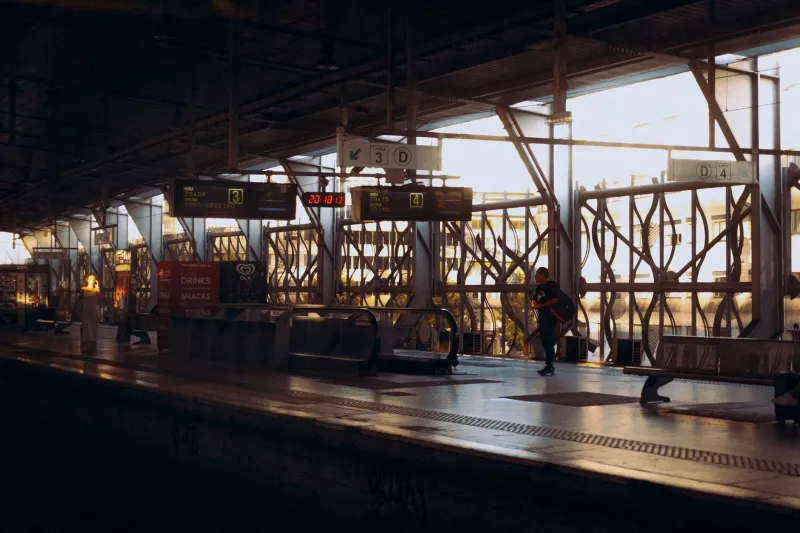
In American suspense, the most frightening object is rarely a knife. It is a timetable. A schedule promises order, but the thriller reads it as prophecy: the 7:42 will arrive, the platform will clear, and the person waiting will be left alone with whatever the hour has planned. The bus that never arrives is not a failure of public transit. It is a success of narrative engineering, a way of converting an ordinary wait into a countdown that belongs to one person.
The Timetable as Prophecy
A printed schedule is a text that appears to know the future. It tells the commuter when to stand, when to move, and when to expect rescue. Suspense writers exploit that authority. In Paula Hawkins's The Girl on the Train (2015), the railway timetable is both ritual and accusation: Rachel's daily passage structures her alibi, her observations, and her disintegration. The train does not simply carry her; it counts the days against her. The schedule becomes a kind of prophecy, and the reader learns to dread the moment it is fulfilled.
The same logic drives The Taking of Pelham One Two Three (1973), in which a subway car is hijacked and the transit system's own precision becomes the hostage clock. The train's route is a row of stations, and each stop is a number falling. The hijackers do not invent a deadline; they borrow one from the transit authority. That is the quiet cruelty of the trope. The countdown is not imposed from outside. It was already printed, posted, and distributed to the public.
Announcements as Warnings
Public address systems are built to be ignored. In suspense, they become oracles. A delay announcement that sounds routine to a crowd can sound like a reprieve to one passenger and a death sentence to another. The voice from the ceiling is impersonal, which makes it feel omniscient. It does not know the protagonist's name, yet it seems to be speaking directly to the protagonist's situation.
Speed (1994) turns a city bus into a metronome: the vehicle must keep moving, and every stop is a threat. The transit infrastructure — the route, the fuel gauge, the traffic signal — becomes a visible countdown. The Commuter (2018) places a man on a train and lets a stranger's proposition attach itself to the conductor's announcements. Each stop marks a moral decision. The announcement is not background noise. It is the sound of the plot advancing.
In real American stations, riders are told to report unattended bags and suspicious behavior. In fiction, that civic instruction curdles into a warning aimed at the reader: someone has already been noticed, and the announcement is the first sign that the ordinary crowd has become a cast.
The Stranger Beside You
The stranger on public transit is a narrator you cannot verify. In Strangers on a Train (1951), a train compartment becomes a confessional, and the man across the aisle turns another passenger's private wish into a plot. The stranger does not need to be supernatural. He only needs to be close enough to hear, and confident enough to speak as though he already knows the ending.
Source Code (2011) repeats a train journey until the repetition itself becomes a countdown. The passenger beside the protagonist may be a witness, a victim, or a liar, and the film's suspense depends on the impossibility of sorting those roles in time. Bullet Train (2022) fills a confined transit car with competing narrators, each with a hidden agenda. The reader or viewer is forced to decide which passenger's account to trust, knowing that the wrong choice may be the one the plot is counting on.
This is why transit is such an efficient suspense setting. It is public enough to supply anonymous threats and private enough to make the protagonist feel singled out. The stranger beside you is not simply a suspect. He is a competing version of events.
When the Platform Empties
The emptying platform is one of suspense cinema's most reliable images. A crowd is a false safety; when it thins, the protagonist is exposed. In The Lady Vanishes (1938), a train journey becomes a test of who will be believed, and the disappearance at the center of the plot depends on the cooperation of strangers. The train is a sealed world, but the platform is the threshold where the world can decide to leave you behind.
The bus that never arrives works by negative space. The absence is the deadline. The protagonist waits, checks the board, waits again, and the reader understands that the schedule is not late — it is refusing. In suspense, a refused schedule is a sentence. The platform does not need an attacker. It only needs to empty.
Why the Countdown Belongs to the Reader
Transit suspense works because most readers have stood on a platform and felt the small, irrational pressure of a timetable. The fiction does not invent that feeling. It sharpens it. The schedule is a prophecy, the announcement is a warning, and the stranger is a narrator. The reader boards the same machine on the page that they board in the morning.
That is the lesson for anyone writing or reading in the shadow of a countdown. The most personal deadline is often the one printed for everyone. The departure board does not say your name. It does not have to. It knows when you will be alone.